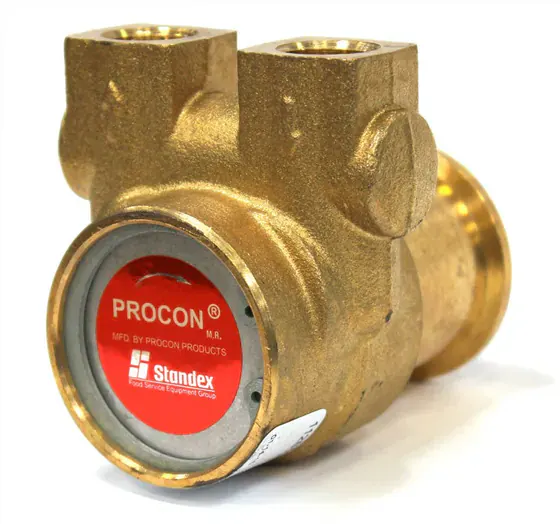
Commercial Rotary Vane Positive-Displacement Pump (Procon-Style)
Commercial brass/SS316 positive-displacement rotary vane pump pushing steady 100–250 PSI for 200–1500 GPD skids.
Couples to standard 48Y NEMA or European C-face carbonator motors via clamp-on V-band or 2-bolt flanges. Precision graphite vanes inside a honed brass or SS316 liner pump smooth pulse-free water up to 250 PSI for commercial foodservice RO skids, espresso loops, and misting plants.
Common Size / Rating Options
Lead-Free Brass
Application Scale & Replacement Verification
Scale: Commercial ROBrand: Engineering Family
Compare housing dimensions, port diameter, and membrane GPD capacity before ordering spares or requesting local dealer quotes. Verify System Fit in Water Planner →
Before You Install: Install an inline 5 µm (or 1 µm) pre-filter + brass/SS Y-strainer and a Low-Pressure dry-run switch directly ahead of pump suction, and verify shaft rotation direction on the coupling end.
Key Technical Specs
| Engineering Category | Commercial RO · Rotary Vane Commercial RO Pumps |
|---|---|
| Field Variants Tracked | 672 dimensional & pressure configurations |
| Industry Standards | NSF/ANSI 169 · NSF/ANSI 61 · WRAS |
| Flow Gph | 50 GPH, 100 GPH, 125 GPH, 140 GPH (+3 more) |
| Material | Lead-Free Brass, SS316 Stainless Steel |
| Mount | Clamp-On Carbonator Style, 2-Bolt Flange Mount |
| Relief | With Internal Balanced Relief Valve, Without Internal Relief Valve |
Right Fit When
- 200–1,500 GPD commercial foodservice/espresso RO skids and booster stations.
- Clean pre-filtered municipal feeds (SS316 body mandatory for low-TDS permeate or deionized applications!).
- Field aliases & trade names: Procon Pump, Brass Vane Pump, Espresso/Commercial RO Feed Pump, Carbonator Pump.
- Engineered to NSF/ANSI 169, NSF/ANSI 61, WRAS criteria where applicable.
When To Skip or Double-Check
- NEVER run a rotary vane pump dry for even 3 seconds or feed unfiltered gritty borewell water—tight carbon-graphite vane tolerances seize instantaneously on a single grain of sand!
Signs This Part Is Failing
- Pump seizing from sediment grit (requires 5µm pre-filter!)
- Sheared motor coupling key
- Worn graphite vanes dropping output pressure
Diagnostic Checklists If Something Goes Wrong
Step 1 · Check pump seizure vs sheared motor drive key
Does the electric motor hum and trip overload, OR spin freely with zero water pressure out?
Turn power OFF, unclamp the pump from the motor, and try turning the pump shaft flat by hand with a small wrench.
Common Questions
Brass vs Stainless Steel (SS316) Procon pump—which do I need?
Use lead-free Brass on raw city water ahead of RO membranes; use SS316 anytime the pump pushes corrosive low-TDS RO permeate, deionized water, or carbonated beverages.
Clamp-on vs Bolt-on mounting—how do I match my motor?
Measure your motor face: round grooved nose takes a stainless V-band clamp-on pump; 2-bolt threaded flange takes bolt-on pumps.