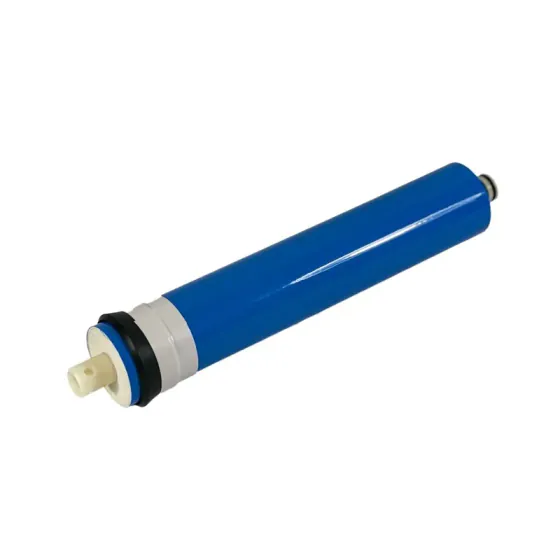
Stage 4 · MembraneService window: 24–36 months
RO Membrane
The heart of the system: separates pure water from dissolved salts.
Spiral-wound thin-film sheets let water molecules through while rejecting most salts, metals and nitrates. It is the part most sensitive to chlorine.
Key Technical Specs
| Rejection | 95 – 98 % when healthy |
|---|---|
| Format | 1812 (domestic), 2012 or 3012 (high flow) |
| Rated output | 50 – 150 GPD (domestic) |
| Feed limit | About 2,000 ppm TDS for standard units |
| Chlorine tolerance | Below 0.1 ppm |
Membrane format guide
| Format | Approx. size | Typical output | Typical use |
|---|---|---|---|
| 1812 | 1.8 × 11.75 in | 50 – 100 GPD | Under-sink home units |
| 2012 | 2.0 × 11.75 in | 100 – 150 GPD | Large households |
| 3012 | 3.0 × 11.75 in | 300 – 400 GPD | Offices and clinics |
| 4040 | 4.0 × 40 in | 2,000+ GPD | Commercial plants |
4-Step Service & Replacement
- 1Confirm carbon pre-filters are fresh so chlorine never touches the new element.
- 2Open the vessel cap and pull the spent element straight out with pliers.
- 3Lubricate the twin stem O-rings lightly with silicone and push bottom-first.
- 4Discard the first two tank fills (~45 min) to purge factory preservative.
Common Questions
Why is TDS briefly high right after fitting a new membrane?
Factory sodium metabisulfite preservative reads high TDS until flushed out for 30–60 minutes.
Can you upgrade a 50 GPD membrane to 100 GPD?
Yes, within the same 1812 housing—just step up the matching drain flow restrictor from 300cc to 450–550cc.