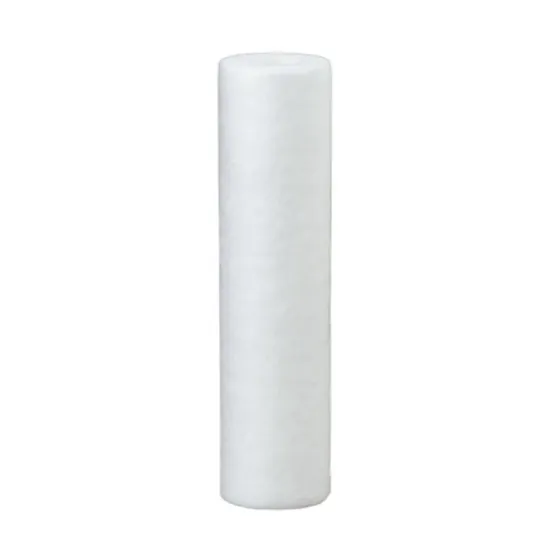
Stage 1 · Pre-filtrationService window: 3–6 months
Sediment Filter
Catches sand, rust and silt before they reach the rest of the system.
Water is forced through dense polypropylene fibre that blocks particles larger than its micron rating. Without it, grit clogs the carbon block and wears the pump valves.
Key Technical Specs
| Typical rating | 1 – 5 micron |
|---|---|
| Common sizes | 10 in or 20 in, slim or jumbo |
| Material | Polypropylene (spun or string-wound) |
| Sits | First stage, ahead of the carbon block |
Choosing a micron rating
| Water source | Rating | Why |
|---|---|---|
| Clean municipal supply | 5 micron | Enough protection, lasts longest |
| Muddy or sandy bore water | 20 micron, then 5 micron | A coarse first stage stops early clogging |
| Fine silt or clay | 5 micron, then 1 micron | Catches fines the first stage lets through |
4-Step Service & Replacement
- 1Close the cold-water inlet ball valve and press the red bleed button.
- 2Unscrew the Stage 1 sump bowl and wash out trapped sediment.
- 3Remove shrink wrap from the fresh cartridge and seat it vertically.
- 4Lightly grease the bowl O-ring with silicone and hand-tighten plus 1/4 turn.
Related Symptoms & Faults
Weak Faucet Flow or Slow Refill
The tap drops to a trickle after one cup, or the tank takes hours to fill.
Booster Pump Clicking On and OffPump pulses ON-OFF-ON every few seconds instead of shutting off smoothly.
Weeping Push-Fit Fitting or BowlSlow drips appear under the sink around tube collets, threads or filter bowls.
Common Questions
Can you wash and reuse a melt-blown PP sediment cartridge?
No. Spun polypropylene traps fine silt deep inside its inner wall thickness, so surface rinsing leaves inner pores blocked.
Should Stage 1 be 5 micron or 1 micron?
Start with 5 micron in Stage 1 to maintain flow and avoid rapid choking on municipal or bore water.