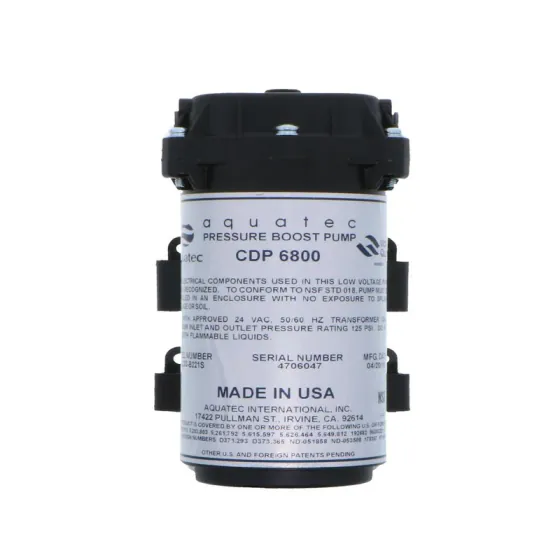
Stage 3 · Pumping & controlService window: 24–48 months
Booster Pump
Lifts feed pressure to what the membrane needs to work properly.
A small diaphragm pump raises pressure to 70 – 100 psi. Higher pressure pushes more pure water through the membrane and rejects more salt.
Key Technical Specs
| Supply | 24 V DC from an external adaptor |
|---|---|
| Working pressure | 70 – 100 psi |
| Rated output | 50 – 150 GPD (domestic), up to 400 GPD (semi-commercial) |
| Sits | Between the carbon block and the membrane |
Pump and power supply pairing
| Membrane size | Pump class | Adaptor (minimum) |
|---|---|---|
| 50 – 75 GPD | 75 GPD pump | 24 V, 1.5 A |
| 100 – 150 GPD | 100 – 150 GPD pump | 24 V, 2.5 A |
| 300 – 400 GPD | 300 – 400 GPD pump | 24 – 36 V, 3 – 4 A |
4-Step Service & Replacement
- 1Unplug the 24V power supply and close both feed and storage tank valves.
- 2Check the molded flow arrow on the front manifold before disconnecting tubing.
- 3Match output voltage and ensure the power brick meets or exceeds rated amps.
- 4Bleed trapped air via the membrane housing before closing the HPS loop.
Common Questions
Should the booster pump sit before or after pre-filters?
Always install after Stage 1 sediment filtration so grit does not scar internal diaphragm valves.
Can I use a 24V 3A power adaptor on a 1.5A booster pump?
Yes. The pump draws only the current it needs, while the higher-rated adaptor stays cooler.