ToolsService window: 24–48 months
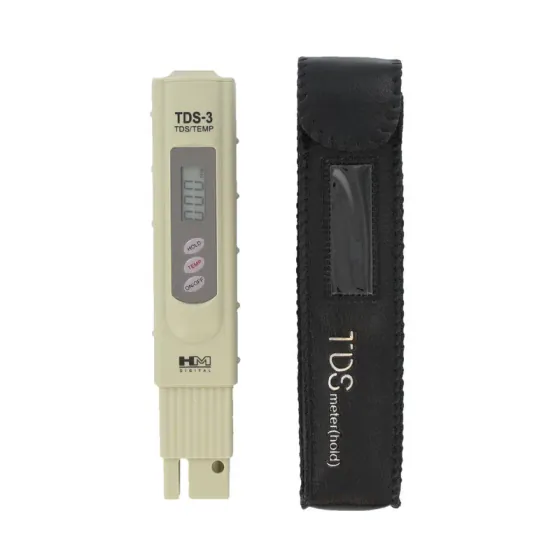
TDS Meter
Measures dissolved salts so you can check membrane health.
A pen that reads electrical conductivity and converts it to parts per million. Compare feed with product water to calculate membrane rejection.
Key Technical Specs
| Range | 0 – 9,990 ppm |
|---|---|
| Accuracy | ± 2 % typical |
| Calibrate | Every 6 months in 342 ppm solution |
| Formula | Rejection % = (feed − product) ÷ feed × 100 |
4-Step Service & Replacement
- 1Rinse a clean glass twice with the sample water before measuring.
- 2Measure raw feed TDS and pure permeate TDS BEFORE any mineral stage.
- 3Swirl probes gently to release micro air bubbles and wait 5 seconds to stabilize.
- 4Dry electrodes after use and calibrate twice yearly in 342 ppm NaCl reference.
Common Questions
Does a TDS meter measure bacteria or chlorine?
No. TDS meters measure dissolved ionic salts; biological microbes require separate water testing.
What TDS rejection percentage indicates a healthy membrane?
Healthy TFC membranes achieve 95–98% salt rejection (e.g., 500 ppm down to 10–25 ppm).