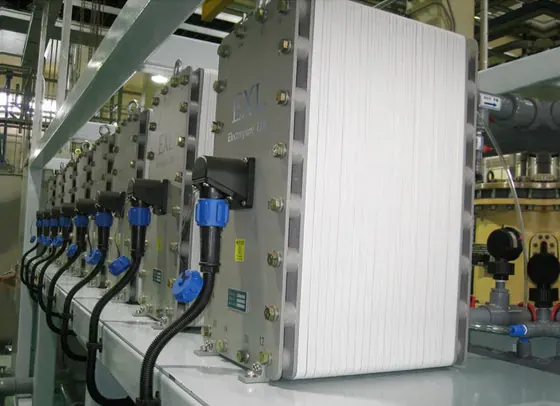
Continuous Electrodeionization (CEDI / EDI) Stacks & DC Power Rectifiers
Continuous Electrodeionization (CEDI/EDI) stacks & DC power rectifiers polishing RO permeate to 10–18.2 MΩ·cm.
Replaces hazardous acid/caustic mixed-bed DI chemical regeneration cleanly: ion-exchange resins and ion-selective membranes inside a DC-powered stack continuously migrate residual ions out into a small concentrate stream—delivering steady 10–18.2 MΩ·cm ultrapure water for pharma, power plants, and microelectronics.
Application Scale & Replacement Verification
Scale: Industrial ROBrand: Engineering Family
Compare housing dimensions, port diameter, and membrane GPD capacity before ordering spares or requesting local dealer quotes. Verify System Fit in Water Planner →
Before You Install: Keep feed hardness strictly <1.0 ppm (use Double-Pass RO or softener/CO2 membrane degasser upstream!) and verify positive brine/electrode reject flow BEFORE ever switching on the DC rectifier.
Key Technical Specs
| Engineering Category | Industrial RO · Electrodeionization (CEDI/EDI) Systems |
|---|---|
| Field Variants Tracked | 24 dimensional & pressure configurations |
| Industry Standards | CE · UL · USP Water / ASTM D1193 Type I |
| Flow | 0.5-1 GPM (100-250 LPH), 2-5 GPM (500-1100 LPH), 6-12 GPM (1400-2700 LPH), 15-25 GPM (3400-5700 LPH) |
| Series | Ionpure VNX/LX-Style Module, Electropure XL-Style Module, Dedicated EDI DC Switch-Mode Rectifier Power Supply |
| Grade | Industrial Power/Boiler Grade (>10 MOhm), Pharmaceutical/Semiconductor Grade (>18 MOhm) |
Right Fit When
- Two-pass RO systems or high-rejection RO loops feeding pharma PW, lab ultrapure, and boiler makeup.
- Matched DC power rectifiers (0–600V DC regulated constant-current/voltage control).
- Field aliases & trade names: Ionpure EDI, Electropure CEDI, Ultrapure 18 MOhm Stack, Chemical-Free Polish Stack.
- Engineered to CE, UL, USP Water / ASTM D1193 Type I criteria where applicable.
When To Skip or Double-Check
- NEVER feed single-pass high-hardness RO permeate (>1.0 ppm CaCO3 as hardness, >0.5 ppm silica, >0.05 ppm Cl2, or >10 ppm CO2/TEA) into an EDI stack—hardness precipitates rock-hard scale inside the DC concentrate chambers and ruins expensive stacks rapidly!
Signs This Part Is Failing
- Sharp drop in product resistivity (<5 MΩ·cm)
- Elevated stack voltage/low current from calcium scaling (feed hardness must be <1 ppm as CaCO3 and CO2 <10 ppm)
Diagnostic Checklists If Something Goes Wrong
Step 1 · Diagnose product resistivity drop (<5–10 MΩ·cm)
Did EDI outlet resistivity fall while feed RO conductivity climbed or dissolved CO2 rose?
Measure RO permeate conductivity (<20 µS/cm ideal), feed hardness (<1 ppm), and CO2 before the stack.
Common Questions
Why does almost every EDI skid require Double-Pass RO (or Softener + Degasser) ahead of it?
Single-pass RO often passes 10–30 ppm TDS plus dissolved CO2 gas on hard borewell water; Double-Pass RO drives hardness well below 0.5 ppm CaCO3 so EDI stays scale-free at 17–18 MΩ·cm for years.
Can you sanitize an EDI stack with chlorine or hot water?
Never use chlorine (destroys ion-exchange resins and membranes!); use only specialized hot-water-sanitizable (HWS) EDI stacks rated for 80–85°C hot loops or gentle peracetic/peroxide cleans per OEM manual.