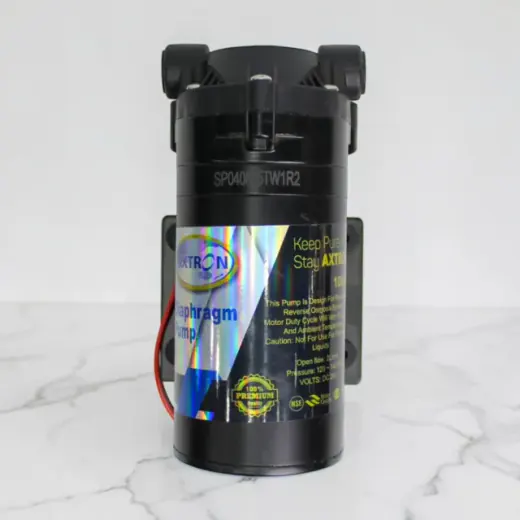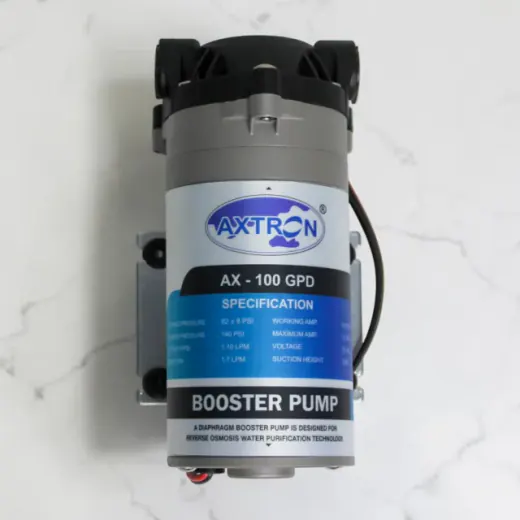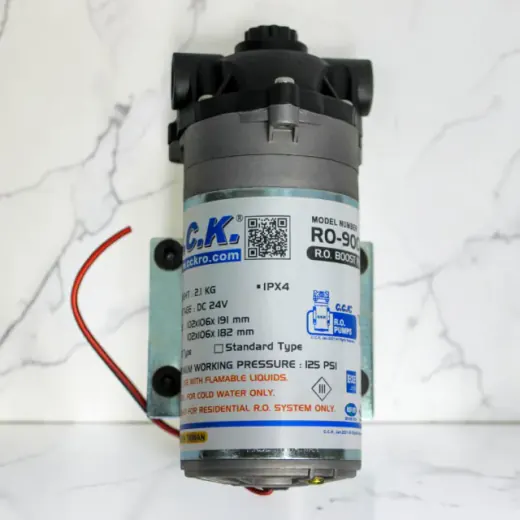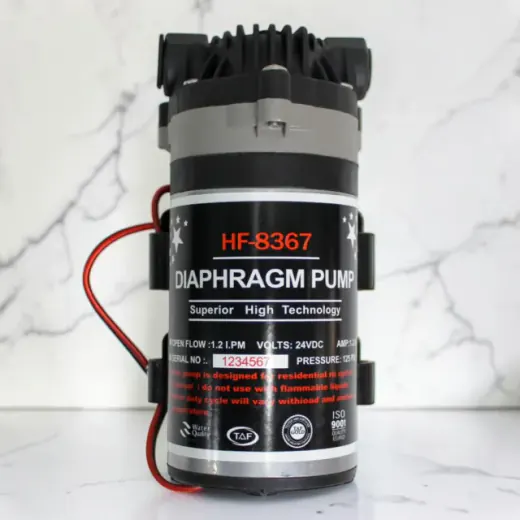
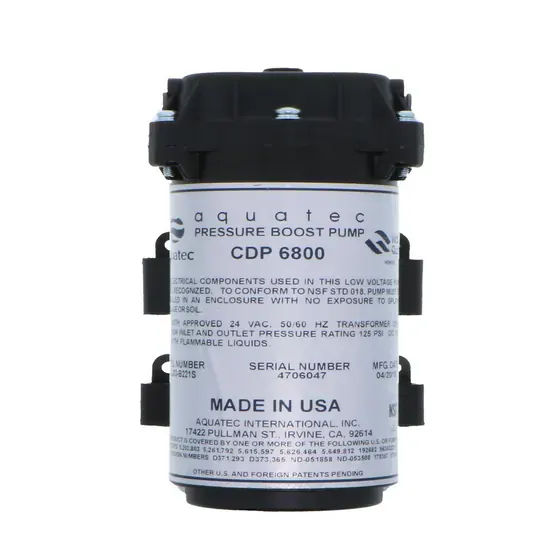
Diaphragm RO Booster Pump
Quiet 3-chamber 24V/36V diaphragm booster pump lifting low mains pressure to 70–120 PSI for RO membranes.
Self-priming positive-displacement 3-chamber diaphragm pump engineered to raise weak city or roof-tank gravity pressure (<35 PSI) up into the 70–120 PSI membrane sweet spot—maximizing pure output LPH, cutting drain waste ratio, and lifting % salt rejection across 50 to 800 GPD RO setups.
Common Size / Rating Options
50 GPD75 GPD100 GPD150 GPD
Application Scale & Replacement Verification
Scale: Pumps & ElectricalBrand: Engineering Family
Compare housing dimensions, port diameter, and membrane GPD capacity before ordering spares or requesting local dealer quotes. Verify System Fit in Water Planner →
Before You Install: Check pump amperage at full pressure: a 100 GPD pump pulls ~1.8–2.2A and a 400 GPD pump pulls ~4A—pair with an equal-or-higher-amp 24V/36V SMPS so voltage never drops under load.
Key Technical Specs
| Engineering Category | Pumps & Electrical · Diaphragm Booster Pumps |
|---|---|
| Field Variants Tracked | 4,833 dimensional & pressure configurations |
| Industry Standards | NSF/ANSI 58 · CE · UL / RoHS |
| Gpd | 50 GPD, 75 GPD, 100 GPD, 150 GPD (+6 more) |
| Voltage | 12VDC, 24VDC, 24VAC, 36VDC (+3 more) |
| Port | 1/4" QC Push-Fit, 3/8" QC Push-Fit, 3/8" Female NPT, 1/2" Female NPT (+1 more) |
| Bypass | Adjustable Internal Bypass (100-125 PSI), Fixed Relief Bypass (110 PSI), No Internal Bypass (External Switch Controlled) |
Right Fit When
- Low-pressure municipal supplies (<40 PSI) and gravity overhead-tank installations.
- Matched to 24V/36V SMPS power supplies and LPS/HPS pressure control switches.
- Field aliases & trade names: RO Booster Pump, Aquatec 6800/8800/5800 Pump, Kemflo Booster, RO Motor (PK/IN).
- Engineered to NSF/ANSI 58, CE, UL / RoHS criteria where applicable.
When To Skip or Double-Check
- Never plumb ahead of Stage 1 sediment filtration (sand grit wrecks check flappers immediately) and never run 24/7 nonstop like centrifugal multistage pumps without rest cooling.
Signs This Part Is Failing
- Pump hums without building pressure (worn diaphragm/cam bearing)
- Leaks from pump head weep-hole
- Intermittent cycling from stuck internal bypass
Diagnostic Checklists If Something Goes Wrong
Step 1 · Dead-head / working pressure gauge check
Does discharge pressure stall below 50–60 PSI while the motor spins smoothly?
Tee a 0–150 PSI glycerin gauge onto the pump outlet port cleanly.
Common Questions
How long do diaphragm booster pumps normally last?
Usually 3–5 years when Stage 1 sediment keeps sand out of the head and LPS/HPS switches prevent dry running or dead-head stalling.
Can you replace just the head instead of the whole pump?
Yes—if the electric motor spins smoothly and quietly, swapping a 3-bolt diaphragm head kit restores brand-new pressure.