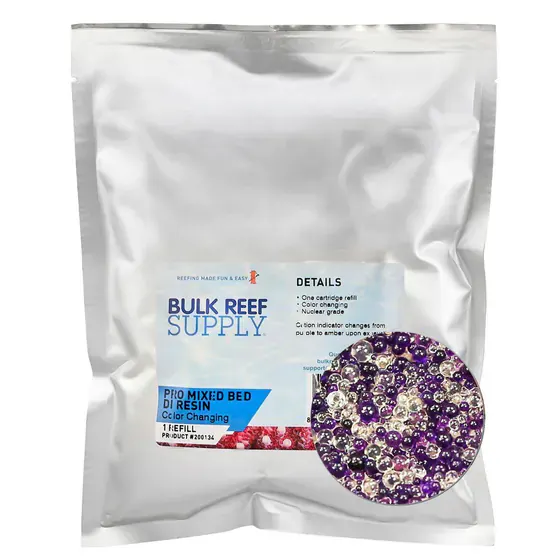
Mixed-Bed & Color-Changing Deionization (DI) Post-Filter Cartridges
Mixed-bed & color-changing DI resin cartridges polishing RO permeate down to 0 ppm TDS (18.2 MΩ·cm).
Packed tightly with balanced strong-acid cation (H⁺) and strong-base anion (OH⁻) nuclear-grade ion-exchange resins to capture the last 1–5% trace salts, silicates, and phosphates escaping an RO membrane—delivering true 0 ppm TDS water for reef aquariums, labs, and spot-free detailing.
Common Size / Rating Options
Single2-Pack4-Pack8-Case
Application Scale & Replacement Verification
Scale: Post-FiltrationBrand: Engineering Family
Compare housing dimensions, port diameter, and membrane GPD capacity before ordering spares or requesting local dealer quotes. Verify System Fit in Water Planner →
Before You Install: Pack refillable DI cartridges tightly—tap the canister firmly on a bench every inch while filling so water cannot channel upward around loose resin beds, and always run vertically bottom-to-top.
Key Technical Specs
| Engineering Category | Post-Filtration · Deionization (DI) Polishing Cartridges |
|---|---|
| Field Variants Tracked | 120 dimensional & pressure configurations |
| Industry Standards | Laboratory Type I/II Grade · NSF/ANSI 61 Resin |
| Format | 2"x10" Inline 1/4" QC, 2.5"x12" Inline 1/4" QC, 10" Slim Drop-In Refillable, 20" Slim Drop-In Refillable (+2 more) |
| Resin Type | Nuclear-Grade Mixed-Bed 40/60 DI, Color-Changing Amber-to-Blue Mixed-Bed DI, Color-Changing Purple-to-Amber Mixed-Bed DI, Strong Acid Cation (H+) Cartridge (+1 more) |
| Pack | Single, 2-Pack, 4-Pack, 8-Case |
Right Fit When
- Reef aquariums (RO/DI), hydroponics, lab glassware, and spot-free car/window rinse systems.
- 10"/20" clear refillable housings or sealed 2"×10" inline housings strictly AFTER an RO membrane.
- Field aliases & trade names: DI Filter, Zero-TDS Cartridge, Reef RO/DI Stage, Spot-Free Resin Cartridge.
- Engineered to Laboratory Type I/II Grade, NSF/ANSI 61 Resin criteria where applicable.
When To Skip or Double-Check
- NEVER run raw un-RO tap water straight into DI resin (exhausts resin in hours) and NEVER use 0-ppm DI water for everyday drinking or un-passivated copper/brass espresso boilers.
Signs This Part Is Failing
- Output TDS climbing from 0 ppm to 1+ ppm
- Color-changing resin turning completely amber/brown
- Fishy amine odor from exhausted anion resin
Diagnostic Checklists If Something Goes Wrong
Step 1 · Catch 0 -> 1+ ppm breakthrough via post-DI TDS check
Did outlet TDS rise from 0 ppm to 1–5 ppm or did color-changing resin turn completely amber/tan?
Read a dual inline TDS meter comparing Post-RO (In) vs Post-DI (Out).
Common Questions
Why does my DI resin exhaust in weeks even when RO water is only 10 ppm?
High dissolved CO2 gas in borewell water passes freely through RO membranes and rapidly eats up the anion half of DI resin—degassing RO water or adding a separate anion stage fixes it.
Is 0 ppm DI water safe to drink?
While non-toxic in small sips, DI water tastes flat/acidic, strips minerals, and can leach metals from pipes; stick to remineralized RO for drinking.