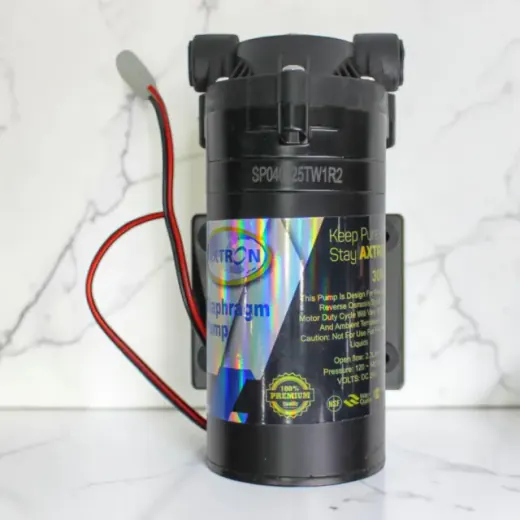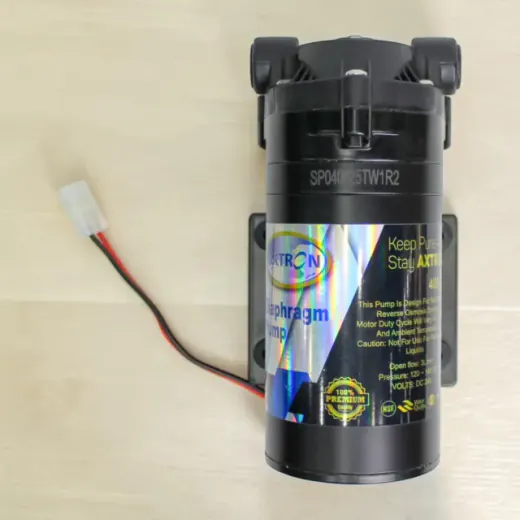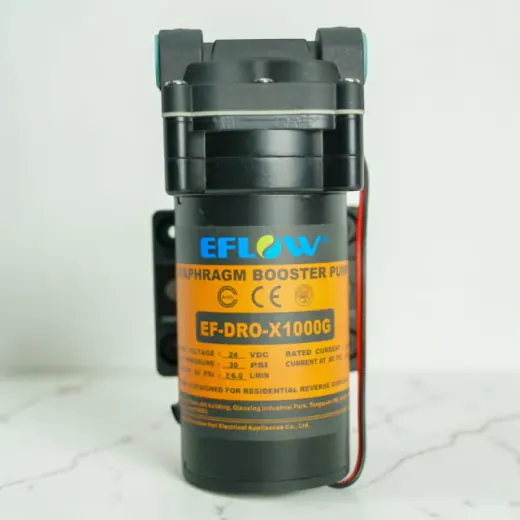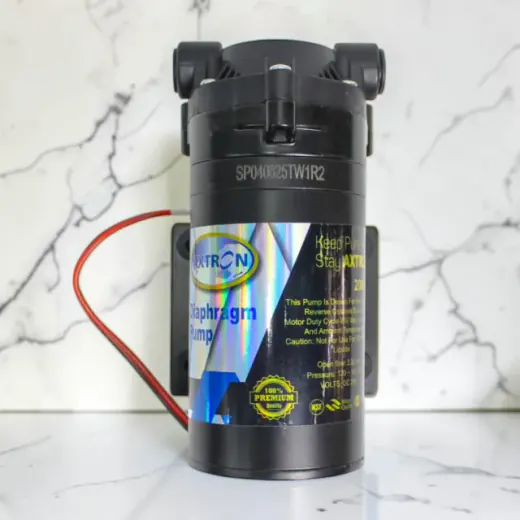
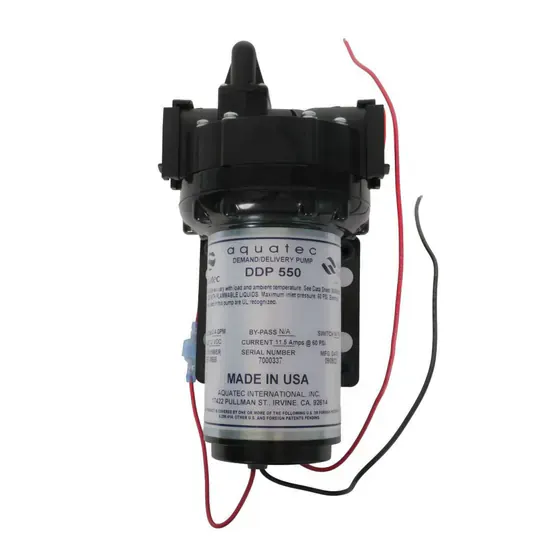
Self-Priming RO Delivery & Demand Booster Pump
Self-priming atmospheric tank delivery pump pushing stored RO water to distant taps, ice makers & espresso bars.
Unlike membrane booster pumps that push dirty feed into an RO vessel, a demand delivery pump pulls clean RO permeate out of an unpressurized atmospheric holding tank (up to 1.8 m lift) and supplies steady 40–60 PSI pressure on demand via an integral shutoff pressure switch.
Common Size / Rating Options
12VDC24VDC24VAC110VAC
Application Scale & Replacement Verification
Scale: Pumps & ElectricalBrand: Engineering Family
Compare housing dimensions, port diameter, and membrane GPD capacity before ordering spares or requesting local dealer quotes. Verify System Fit in Water Planner →
Before You Install: Add a small pressurized hydropneumatic accumulator tank (set 2–3 PSI below pump cut-in) directly on the pump outlet—without an accumulator buffer, opening a small water glass slams the integral pressure switch ON/OFF violently.
Key Technical Specs
| Engineering Category | Pumps & Electrical · Demand & Delivery Pumps |
|---|---|
| Field Variants Tracked | 960 dimensional & pressure configurations |
| Industry Standards | NSF/ANSI 58 · NSF/ANSI 61 · CE |
| Flow | 0.7 GPM, 1.0 GPM, 1.5 GPM, 2.0 GPM (+2 more) |
| Voltage | 12VDC, 24VDC, 24VAC, 110VAC (+1 more) |
| Cutoff | 40 PSI Demand Switch, 60 PSI Demand Switch, 80 PSI Demand Switch, 100 PSI Demand Switch |
| Port | 3/8" QC Push-Fit, 3/8" Female NPT, 1/2" Female NPT, 1/2" Hose Barb |
Right Fit When
- Commercial cafes, offices, and large villas distributing permeate from 200L–2,000L atmospheric tanks.
- Long-distance fridge ice-maker, pot-filler, and espresso manifold runs.
- Field aliases & trade names: RO Delivery Pump, Atmospheric Tank Repressurization Pump, Espresso/Fridge Supply Pump, Aquatec DDP 5800.
- Engineered to NSF/ANSI 58, NSF/ANSI 61, CE criteria where applicable.
When To Skip or Double-Check
- Verify wetted elastomer compatibility (EPDM/Santoprene—never standard brass bodies!) for ultra-pure low-TDS RO water, and always install a 2–5 gal accumulator tank to stop rapid pump chatter.
Signs This Part Is Failing
- Pulsating faucet flow
- Pump running continuously without shutting off (failed integral pressure switch)
- Loss of prime from suction air leak
Diagnostic Checklists If Something Goes Wrong
Step 1 · Diagnose pulsating tap flow & rapid motor cycling
Does the delivery pump cycle ON/OFF every second when pouring a slow glass?
Check accumulator bladder air pre-charge (empty tank air PSI should sit 2–3 PSI below pump cut-in).
Common Questions
Booster pump vs Delivery pump—can I swap them?
No—RO booster pumps generate high 80–120 PSI at low flow without integral pressure switches; demand delivery pumps run high GPM at 40–60 PSI with built-in tap-demand cutoff switches.
Why does a delivery pump need brass-free wetted heads on RO water?
Low-TDS RO water leaches copper and lead from brass pump heads; insist on polypropylene, nylon, or SS304/316 wetted bodies.