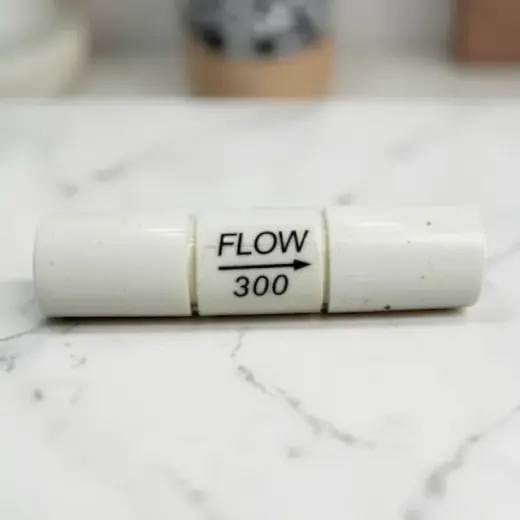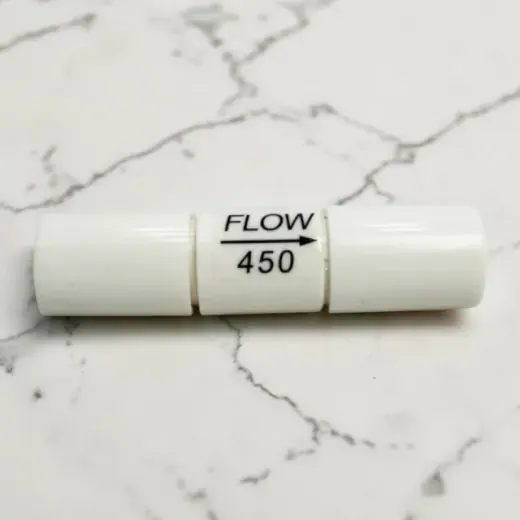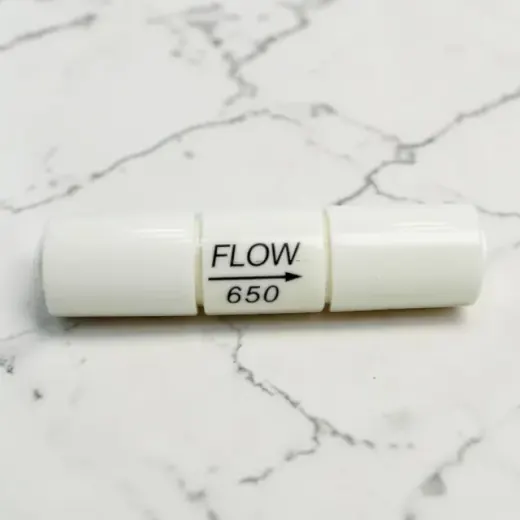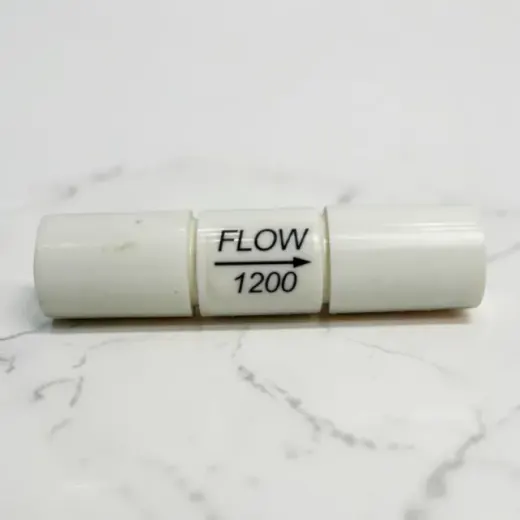
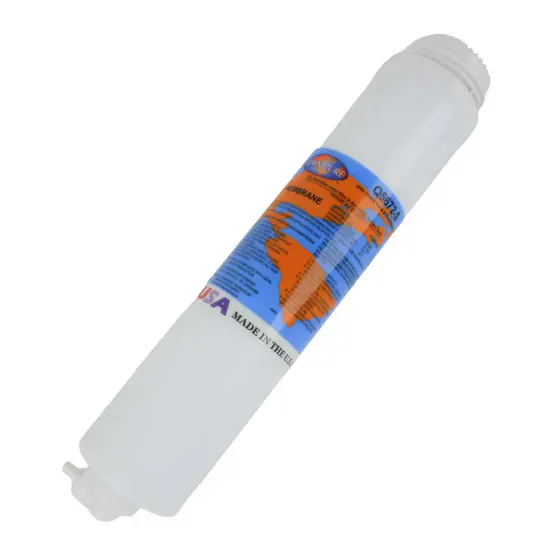
RO Capillary & Inline Waste Flow Restrictors
Calibrated 200–1,500 cc/min brine capillary restrictors maintaining membrane pressure & waste flush ratio.
Installed on the membrane reject/drain line to create ~70–90 PSI internal housing back-pressure so water forces through the 0.0001 µm membrane while allowing calibrated brine flow (typically 2:1 to 4:1 waste-to-pure) to flush hardness salts continuously to drain.
Common Size / Rating Options
24 GPD36 GPD50 GPD75 GPD
Application Scale & Replacement Verification
Scale: Fittings & ValvesBrand: Engineering Family
Compare housing dimensions, port diameter, and membrane GPD capacity before ordering spares or requesting local dealer quotes. Verify System Fit in Water Planner →
Before You Install: Mount strictly on the OFFSET brine port of the membrane shell pointing toward the drain saddle, and verify exact cc/min by measuring drain output in a cup for 60 seconds.
Key Technical Specs
| Engineering Category | Fittings & Valves · Flow Restrictors |
|---|---|
| Field Variants Tracked | 927 dimensional & pressure configurations |
| Industry Standards | NSF/ANSI 58 · NSF/ANSI 61 · FDA Food-Grade |
| Gpd | 24 GPD, 36 GPD, 50 GPD, 75 GPD (+9 more) |
| Cc | 150cc/min, 200cc/min, 250cc/min, 300cc/min (+14 more) |
| Port | 1/4" QC Push-Fit, 3/8" QC Push-Fit, 1/4" Jaco Compression, 5/16" Insert |
| Body | Standard Inline Tube Restrictor, Capillary Micro-Tube Insert, Combo Flow Restrictor + Manual Flush Bypass Valve |
Right Fit When
- Matching 50 GPD (300cc), 75 GPD (420–450cc), 100 GPD (550–650cc), 150 GPD (800cc), and 300 GPD (1200cc) membranes.
- 1/4" or 3/8" quick-connect drain lines (fixed inline or integrated auto-flush bypass).
- Field aliases & trade names: FR 300/450/600, Capillary Drain Restrictor, Waste Water Controller, Flow Limiter.
- Engineered to NSF/ANSI 58, NSF/ANSI 61, FDA Food-Grade criteria where applicable.
When To Skip or Double-Check
- NEVER change membrane GPD upward without stepping up the matched cc/min restrictor, and NEVER mount a restrictor on the pure permeate outlet.
Signs This Part Is Failing
- Clogged restrictor: zero wastewater at drain
- Rapid scaling and high TDS
- Missing/broken restrictor: water gushes straight to drain
Diagnostic Checklists If Something Goes Wrong
Step 1 · Measure 60-second drain output in mL
Does drain output fall far below rated cc/min (or drop to zero) while TDS climbs?
Catch 60 seconds of drain water in a measuring cup during active purification.
Common Questions
Does a flow restrictor stop water flowing to drain when the tank is full?
No—the flow restrictor only controls active running waste ratio; the 24V solenoid + HPS (or ASOV + check valve) shuts drain off completely at full tank.
Internal insert capillary vs external inline barrel restrictor—which is better?
External inline barrel restrictors (1/4" push-fit) are far easier to swap, inspect, and pair with parallel flush valves than tiny insert tubes pushed inside the drain hose.