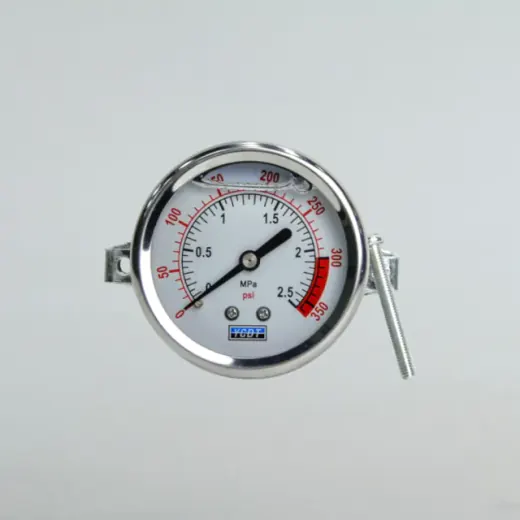
350 PSI Commercial Water Pressure Gauge (& Accurate RO Water Filter Plants)
350 PSI glycerin-filled commercial stainless pressure gauge (Bottom 1/4" NPT) monitoring RO vessel & pump PSI.
Liquid glycerin damping protects the internal brass Bourdon spring and gears from intense multistage pump vibration and pressure pulsations. Lets operators read high-pressure multistage pump discharge and 4040/8040 RO vessel heads (100–250 PSI) accurately without pointer chatter.
Application Scale & Replacement Verification
Scale: Commercial / IndustrialBrand: Axtron
Compare housing dimensions, port diameter, and membrane GPD capacity before ordering spares or requesting local dealer quotes. Verify System Fit in Water Planner →
Before You Install: Use a wrench strictly on the square brass hex flat—NEVER twist the round stainless case by hand or pipe pliers, which snaps the internal capillary weld—and snip or unseal the tiny top rubber vent plug after mounting vertically so internal thermal pressure equalizes.
Key Technical Specs
| System Series | Axtron |
|---|---|
| Pressure Range | 350 PSI max scale |
| Application Duty | Commercial / Industrial |
| Damping / Wetted Design | Glycerin-Filled Brass or SS316 / Acrylic Float |
Right Fit When
- High-pressure RO pump outlets, 4040/8040 feed headers, and concentrate reject manifolds.
- Commercial skid panels using standard 1/4" NPT brass fittings.
When To Skip or Double-Check
- Avoid running 350 PSI gauges on low-pressure 10–40 PSI pre-filters where the first 10% of the dial lacks fine resolution; use a 150 PSI gauge ahead of high-pressure pumps.
Signs This Part Is Failing
- Needle sticks well above 0 PSI even when the RO skid is shut off and depressurized
- Pointer vibrates wildly like a blur (glycerin leaked out or severe pump cavitation)
- Water beads slowly at the 1/4" brass thread root
Diagnostic Checklists If Something Goes Wrong
Step 1 · Check zero-rest accuracy when plant is shut off
Does the pointer stay stuck at 15–40 PSI even with all valves open at atmospheric zero pressure?
Depressurize the header completely and look straight onto the dial.
Common Questions
Why does a glycerin-filled gauge show a small air bubble at the top?
That intentional expansion bubble prevents thermal expansion from blowing out the front lens—keep the top bezel upright during service.
Should I use a 150 PSI or 350 PSI gauge on a 4040 commercial membrane housing?
Use 150 PSI gauges before and after the 20" Jumbo pre-filters, and 350 PSI gauges on the high-pressure pump discharge and concentrate outlet.