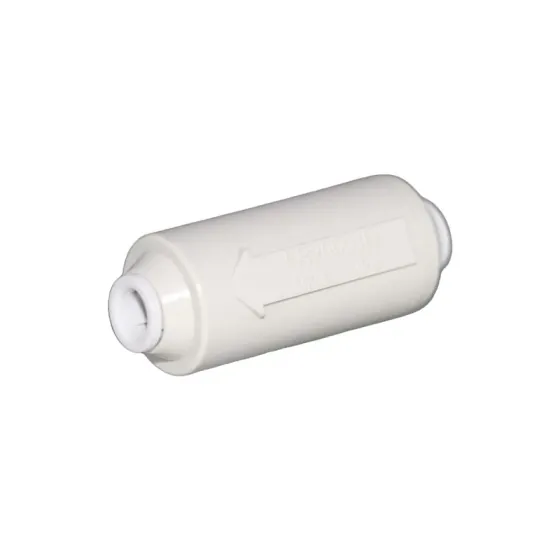
Stage 4 · MembraneService window: 24–36 months
Flow Restrictor
Meters the drain so pressure can build across the membrane.
A calibrated capillary on the drain line holds back pressure inside the membrane housing. Too open and no pure water forms; too tight and the membrane scales.
Key Technical Specs
| Rated in | cc/min of drain flow |
|---|---|
| Port | 1/4 in quick-connect |
| Drain to product ratio | Roughly 2:1 to 4:1 |
| Sits | Membrane drain (waste) port |
Match the restrictor to the membrane
| Membrane | Restrictor | Drain per hour |
|---|---|---|
| 50 GPD | 300 cc/min | about 18 L |
| 75 GPD | 420 cc/min | about 25 L |
| 100 GPD | 550 cc/min | about 33 L |
| 150 GPD | 800 cc/min | about 48 L |
4-Step Service & Replacement
- 1Shut inlet supply, unplug pump power, and depress the 1/4 in collet rings.
- 2Confirm the housing offset port is the drain line—never restrict the center pure port.
- 3Point the flow arrow on the new restrictor squarely toward the drain pipe.
- 4Verify drain output in a measuring cup over 60 seconds matches rated cc/min.
Common Questions
Does a flow restrictor stop water waste when the tank fills?
No. It only meters active flow—the solenoid valve or ASOV + check valve actually stop flow.
What happens if the flow restrictor is undersized?
Inadequate cross-flow flushing lets calcium carbonate crust across the membrane within weeks.